Can a Relationship Survive an Affair?
This is one of the most common questions people ask when searching for counseling for affair recovery.
The honest answer is that some relationships do survive and even become stronger. Others do not. What determines the outcome is not simply remorse. It is whether real repair takes place.
Repair involves:
• full honesty without ongoing trickle truth
• consistent behavior change over time
• empathy for the depth of injury caused
• willingness to answer difficult questions
• examining the vulnerabilities that existed before the affair
• rebuilding emotional safety, not just stopping the behavior
Without repair, the relationship may remain intact on the surface but fractured underneath.
With repair, some couples develop deeper emotional awareness and stronger boundaries than they had before.
What Healing From Betrayal Trauma Actually Looks Like
Healing does not mean forgetting. It means integrating the experience so it no longer dominates your nervous system.
Early in affair recovery, healing may look like stabilizing your body. Sleeping. Eating. Reducing constant activation.
In the middle stages, it involves boundaries, structured conversations, and deciding whether the relationship can feel safe again.
Later, couples may redefine the relationship with stronger communication and accountability.
For many couples, having structured support makes this process more contained and less chaotic. Most people do not know how to recover on their own. Affair recovery is complex and requires a lot of support, understanding, and structure from a skilled affair specialist.
Couples counseling for infidelity provides space to:
• slow reactive cycles
• process betrayal trauma safely
• rebuild communication
• create transparency and accountability
• clarify whether rebuilding trust is possible
As a therapist providing couples counseling in Michigan, including Rochester Hills and Lake Orion, I work with individuals and couples navigating affair recovery and attachment injuries. Many people reach out after searching for answers because the pain feels overwhelming, uncontrollable, and powerless.
You are not alone in that.
If You Are in the Middle of an Affair
Affairs are traumatic. Not just emotionally painful, but destabilizing at a basic nervous system level (in your physical body). When trust is broken, it can feel as though your entire foundation has shifted beneath you.
The shock can be consuming. Anger may rise quickly and feel unfamiliar and frightening. Anxiety can become constant, as if your body no longer knows how to fully rest. These reactions are normal responses to betrayal and signals that your nervous system has been shaken by a profound attachment injury.
With the right support, those trauma responses can begin to settle. Safety can be rebuilt gradually through consistency, honesty, and emotional repair. Over time, clarity returns and the intensity softens. Your body does not stay on high alert forever.
Whether the relationship survives or not, healing is possible. A grounded, steady sense of self is possible again.
With 18 years of experience helping couples navigate betrayal, affair recovery, and attachment injuries, I have seen that even the most destabilizing moments can be worked through with structure and support.
If you are looking for affair recovery counseling in Michigan, including Rochester Hills, Lake Orion, or surrounding communities, you do not have to move through affair recovery alone. Support can help you navigate betrayal with more clarity, stability, and direction.
When someone discovers an affair, the pain is often immediate and overwhelming. Many people describe it as the most destabilizing experience of their lives. Even those who consider themselves strong, secure, or emotionally aware can be caught off guard by the intensity of their reactions. The pain is consuming.
If you are going through this right now, you may be wondering:
Why does this hurt so much?
Why can’t I calm down?
Will I ever feel normal again?
Can a relationship survive infidelity?
These are some of the most asked questions about affair recovery and betrayal trauma. The depth of the pain does not mean you are weak. It means your foundation was shaken.
Affairs Are Traumatic, Not Just Painful
An affair is not simply a relationship conflict. It is a relational trauma.
Trauma is not defined only by physical danger. It is defined by overwhelm, helplessness, and a sudden loss of safety. When infidelity is discovered, the nervous system reacts as if the ground has dropped out from underneath you.
The person who was your source of comfort becomes the source of threat. That contradiction is profoundly destabilizing.
Why am I acting so out of character after discovering my partner had an affair?
From a neurobiological perspective, betrayal activates the brain’s threat detection system. The amygdala signals danger. Stress hormones like cortisol and adrenaline surge. The prefrontal cortex, the part of the brain responsible for logic and regulation, becomes less effective under stress. The brain’s fire alarm is on and it won’t shut off. It can no longer tell the difference between safety and danger which is extremely disorienting.
This is why so many people say:
“I’m raging, but I can’t stop.”
“I feel like I’m losing my mind.”
“I don’t recognize myself.”
You’re not crazy for feeling out of control after discovering a betrayal.
This reactivity causes fear, distress, and guilt. You are not losing your mind. Your nervous system is trying to protect you.
Attachment bonds regulate stress. When that bond is fractured, the body goes into survival mode. This is often referred to as betrayal trauma. It is not dramatic language. It is an accurate description of what happens when emotional safety collapses.
If you’d like to understand more about how attachment bonds activate the stress response, you can read more in my post on how attachment injuries impact the nervous system.
Common trauma responses after an affair include:
• intrusive thoughts that replay conversations or images
• difficulty sleeping or concentrating
• emotional flooding
• hypervigilance and scanning for signs of more dishonesty
• panic when imagining the future
• physical symptoms like nausea, shaking, headaches, or tightness in the chest
These are not signs that you are “handling it badly” or “going crazy.” They are signs your attachment system has been injured. It is normal to feel this way at this stage. There is nothing wrong with you. Your body is responding predictably.
Why the Pain of an Affair Feels So Personal
Even when the affair was driven by avoidance, insecurity, or disconnection, the betrayed partner often internalizes it as a statement about their worth.
Am I not enough?
Was I too much?
How did I not see this?
Infidelity is a double betrayal.
Infidelity disrupts trust in your partner and trust in your own perception.
Many people describe feeling humiliated, foolish, or disoriented. Memories feel distorted. Moments that once felt secure now feel contaminated by doubt.
The brain tries to reconstruct the timeline because it is searching for stability. Obsessive thinking and repeated questioning are common in affair recovery. This is not about punishment. It is about reorienting to reality.
Why You Can’t “Just Move On”
People often feel pressure to move forward quickly. Friends may say, “If you’re staying, you have to let it go.” The partner who had the affair may want to “put it behind you.”
Trauma does not resolve through willpower.
The nervous system does not respond to logic. It responds to safety. Safety is rebuilt slowly through consistency, transparency, accountability, and emotional repair.
When couples attempt to bypass the trauma, it often resurfaces later as resentment, emotional distance, or chronic mistrust. What looks like strength in the short term can create disconnection in the long term.
Affair recovery requires time, structure, and a willingness to tolerate difficult conversations without shutting them down. This is where structured affair recovery counseling can be essential.
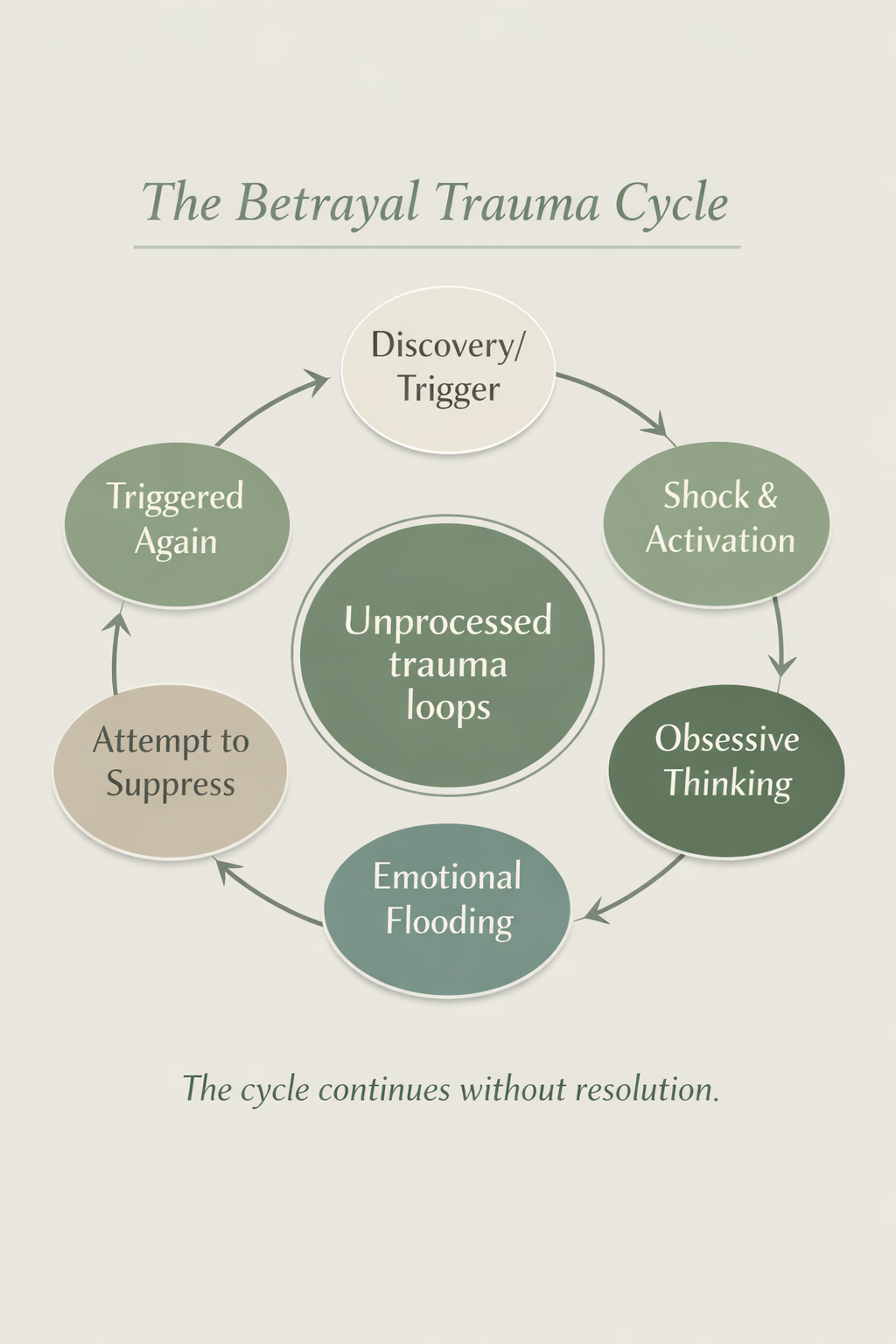
Without structured repair, betrayal trauma tends to repeat in predictable emotional loops.