Why Can't I Stop Thinking About the Affair?
One of the most common things I hear after someone discovers an affair is, "I can't stop thinking about it." Whether people experience an emotional affair or a physical affair, the intrusive thoughts can feel relentless. They replay conversations, reread text messages, mentally reconstruct timelines, and wonder if they've missed something important. They think about the affair while driving to work, folding laundry, making dinner, or trying to fall asleep (if they can sleep). Eventually, many people begin to wonder if something is wrong with them. "Why can't I just let this go?"
The answer is actually quite simple: your mind is trying to make sense of something that doesn't make sense. A healthy brain naturally revisits traumatic experiences, going over them again and again as it works to understand what happened and fit it into a story that makes sense.
Infidelity Dismantles Your Reality
Infidelity doesn't just break trust, it dismantles your understanding of your own life. Before discovery, you had a story about your marriage. You knew who your spouse was, what your relationship meant, and what your shared memories represented. Then discovery happens, and suddenly the story you've been living no longer fits the facts in front of you. You question everything.
You begin looking back at your entire relationship through a completely different lens. Vacations, anniversaries, birthdays, date nights, family traditions, and even ordinary Tuesday evenings are all pulled back into question. Was our marriage ever what I thought it was? Were they happy then? Did they love me? Was I the only one who didn't know? These aren't simply questions about the affair, they're questions about your entire reality.
It's no wonder your mind keeps returning to it. Human beings are wired to create coherent stories about their lives. When something this significant shatters that story, your mind naturally begins trying to put the pieces back together.
Why Your Mind Keeps Replaying the Affair After Discovery
People often tell me they're exhausted by how consumed they feel. They replay conversations they had years ago, remember little moments that once seemed insignificant but now feel loaded with meaning, and mentally compare dates and timelines. They wonder whether they missed obvious signs or ignored their intuition. It's exhausting, and many begin to worry they're becoming obsessive.
But this isn't because you're weak, obsessive, or "going crazy." It's because your mind is trying to reconcile two competing realities: the marriage you believed you were living and the marriage you discovered after the affair. Until those two realities begin to fit together, your thoughts naturally keep returning to the places where they don't align. Your brain is trying to organize an experience that currently feels disorganized and impossible to understand.
Why Intrusive Thoughts After Infidelity Are So Common
This is why so many betrayed partners desperately want answers. From the outside, it can look like they're interrogating their spouse or refusing to move on. From the inside, it feels completely different. They're trying to understand what happened. They want to know when the affair started, how it progressed, what was happening in the marriage at the time, whether it was emotional, physical, or both. They want to know what was true, what was hidden, and how two completely different realities could have existed at the same time.
These are not unreasonable questions. In fact, asking questions is often an important part of healing because understanding helps rebuild a coherent picture of what happened. It fills in missing pieces and allows your mind to begin organizing an experience that currently feels chaotic.
This is one of the places where affair recovery counseling can be incredibly helpful. The goal is not to rush you past the questions or convince you to "just move on." The goal is to help you sort through what information is important for healing, what questions need answers, and what questions may keep you trapped in a cycle of searching for certainty that may never come.
A skilled therapist can help create a space where the pain, confusion, anger, grief, and fear can all be processed without getting lost in the details of the affair. Healing requires both understanding what happened and learning how to begin living again after something that profoundly disrupted your sense of safety.
When the Search Stops Helping
There often comes a point where the search quietly changes. Instead of bringing greater clarity, it begins creating greater distress. You ask the same question again, hoping this time the answer will somehow feel different. You reread old text messages looking for something you may have overlooked. You check the phone "just one more time." You replay conversations before your feet even hit the floor in the morning. You find yourself mentally reviewing the affair dozens of times throughout the day, not because you want to, but because your mind keeps pulling you back there.
None of this means you're failing. It means you're still trying to find solid ground. The problem is that once you've gathered the information necessary to understand what happened, continuing to search often stops producing understanding and starts producing something else. Another painful image. Another unanswered question. Another detail your mind now has to carry.
I've worked with many people who become convinced that if they can just uncover one more piece of information, they'll finally feel better. But there is no bottom of the barrel. If your sense of safety depends on having every answer, there will always be another question to ask, another possibility to consider, or another gap in the timeline.
Over time, this search can become vicariously traumatizing. Instead of helping you make sense of the affair, it keeps you emotionally reliving it. Every new detail becomes another painful experience your mind has to absorb. This creates vicarious trauma, you can’t unsee the movie that plays in your head after finding new information.
That doesn't mean you should stop asking important questions. It means the goal eventually begins to change. In the beginning, the goal is understanding. Later, the goal becomes integrating what you know well enough that your life no longer revolves around trying to solve the unsolvable.
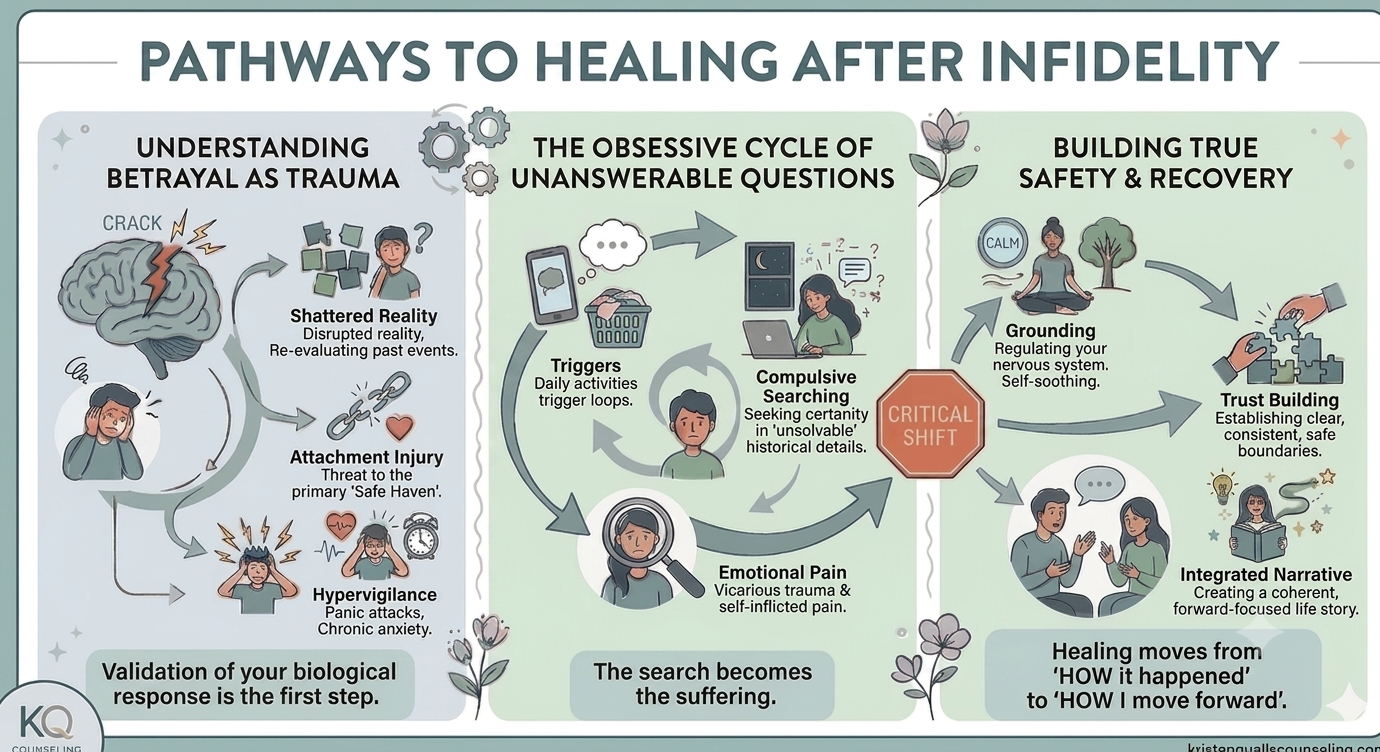
Healing from betrayal trauma means moving your focus from "how the affair happened" to "how I safely move forward."
You Don't Have to Make Sense of Infidelity Alone
Trying to make sense of an affair can feel incredibly lonely. Friends and family often mean well, but they may encourage you to “move on,” stop asking questions, or make a quick decision about whether to stay or leave. While those responses are understandable, they rarely help when your world has been turned upside down.
Unfortunately, friends and family members often become deeply affected by the betrayal as well. They may take sides, develop their own anger toward the person who caused the hurt, or struggle to understand when a couple chooses to repair the relationship. If the marriage heals, those unresolved feelings can sometimes create tension or challenges in those relationships down the road.
Healing isn't about forcing yourself to move on before you're ready. It's about making sense of what happened, understanding how it has affected you, and rebuilding a reality that feels stable enough to stand on again. That process takes time, and it often benefits from having someone who understands both the trauma of betrayal and the complex dynamics that lead to affairs.
In my practice, I work with individuals and couples navigating the aftermath of infidelity. Whether you're trying to decide if your relationship can be repaired or you're committed to rebuilding trust together, my goal is to help you move from confusion to clarity. Together, we'll make sense of what happened, determine what information is important for healing, and help you stop living in the constant cycle of replaying the betrayal.
You don't have to have all the answers before you reach out. If you're ready for support, I'd be honored to walk alongside you as you begin healing.